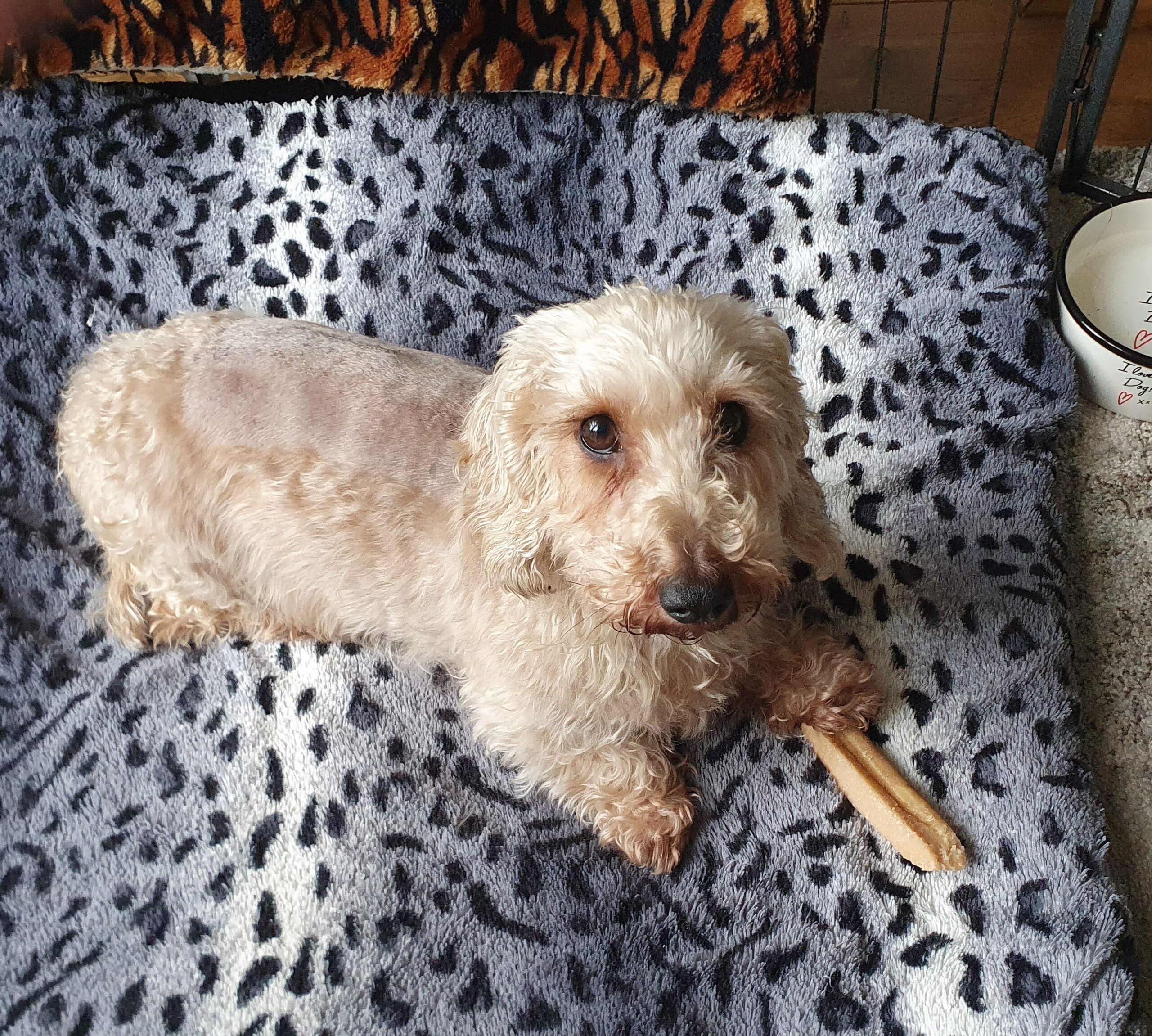
There are five grades of IVDD, with grade 1 being the mildest and grade 5 being the most severe. Dogs with grade 3 or 4 IVDD are between these too extremes. Please scroll down for treatment options for these dogs, home care advice and other useful information.
What do grade 3 and 4 dogs look like?
These dogs cannot use their hind legs to walk. They can still feel their toes (your vet or neurologist will check for this if needed).
- Grade 3 dogs can still choose to move their legs a little if they want to, but they can’t walk without support.
- Grade 4 dogs can’t make any deliberate movements of their hind legs at all (i.e. these legs are paralysed). Most grade 4 dogs can still make a few reflex movements such as twitching, but they can’t control these. As well as being unable to walk, many grade 4 dogs are also incontinent.
 Above: Hetty had grade 3 disc disease at the time of this photo. She could move her hind legs a bit, but she couldn’t walk without sling support.
What to do first
Click here for first aid advice. This will open a free downloadable PDF containing first aid advice for dogs with IVDD. It’s a short extract from The IVDD Handbook.
If your dog has just gone down with IVDD and is unable to walk, they should be seen as soon as possible by your vet for assessment and treatment including painkillers. Ask for the next available appointment. Ask to speak to a vet straight away if your dog seems to be getting worse and worse. A few cases get worse (see below) and may need urgent help.
Important: If your dog seems to be getting worse and worse, ask to speak to your vet immediately. There’s a possibility that urgent referral may be required.
Unless your dog is getting worse and worse, there is no need to rush into surgical referral for IVDD. Most studies show that delaying the operation does not affect the dog’s outcome Davis & Brown, Kazakos et al 2005, Ito et al 2005, Jeffery et al 2016. You should generally have a chance to consider all options and to check your financial position before going for surgery. It can be sensible in some cases to start with non-surgical treatment and then progress to an operation if your dog is not improving. If surgery is delayed, then excellent pain-medication is important, and your dog should either be admitted to the clinic or have frequent repeat visits for monitoring.
Watch out for deteriorating dogs
A few dogs start with mild signs which then get worse. The problem could get worse gradually or suddenly. So it’s important to keep an eye on your dog and to be prepared for a change of treatment plan, especially in the early stages. There’s a big difference in outlook for grade 3 dogs (can’t walk, but hind legs can still move) and grade 5 dogs (can’t walk, paralysed hind legs and no deep pain sensation in toes). If your dog can’t walk and you are considering an operation but hoping to avoid one, have your vet keep a close eye on them for the first few days.
If your dog is getting worse and worse, quick referral for surgery might be wise, ideally before they lose toe pain-sensation.
Deterioration is generally nobody’s fault. It’s just that the disc has herniated over hours to days rather than all at once. As far as possible, prevent your dog from running and jumping during early recovery (see below for more guidance on this). We sometimes hear of dogs who start off mildly-affected, but then suddenly get much worse just after jumping off a sofa or chasing across a room.
Treatment options for grade 3 and 4 dogs
Treatment options are:
- Spinal surgery plus aftercare
or
- Non-surgical treatment (also called conservative management)
Spinal surgery
If your dog can’t walk, an operation might improve their chance of recovery. Spinal surgery should only be performed by someone with specialist training. If your dog is to go for surgery, ask your vet to refer them to a neurologist.
The neurologist assesses the dog and then, under a general anaesthetic, uses advanced imaging (MRI or in a few cases CT or myelography) to confirm which disc spaces are affected and on which side of the spine. Surgical techniques vary depending on these findings.
These days, most spinal surgery procedures involve the removal of disc material that is pressing on the spinal cord. An example of this is the ‘hemilaminectomy’ procedure. To surgically decompress the spine, the surgeon removes a section of vertebral bone overlying the spinal cord and then very carefully removes herniated disc material so that it no longer presses on the spinal cord. In some cases, a ‘fenestration’ procedure is also performed on the affected disc and/or adjacent discs. Fenestration may reduce the risk of the problem recurring. It involves removing the centre of the disc (the nucleus pulposus) via a little window cut out of its side.
After successful spinal surgery, it usually takes these dogs about 1 to 3 weeks to start walking. A few dogs take much longer than this. They are sent home from hospital once they are fairly comfortable and can be managed at home, usually after the first few days. You’ll need to set up a safe indoor recovery space (crate, pen or possibly a recovery room) ready for when your dog comes home. Be prepared – your dog might not yet be able to walk and they might not have perfect bladder and bowel control on returning home.

Above: Home care following surgery typically includes on-lead toilet breaks with sling walking if needed to help support the dog’s hindquarters. Darcy Dolittle needed support from a sling for a few days on coming home to prevent falls. A scarf makes a useful temporary sling.
Non-surgical treatment. Non-surgical treatment can be a reasonable option for these dogs. Most grade 3 and 4 dogs will recover, even without a spinal operation. Recent studies have demonstrated good results without surgery. For example, a UK studyKhan, Jeffery & Freeman 2024 looked at how well dogs recovered without surgery. This study included 51 dogs with grade 3 or 4 IVDD (they couldn’t walk but did have pain sensation in their toes). Within 12 weeks, 49 (96%) of these dogs were walking again without any surgery. Most of them walked much sooner than this. Their treatment included painkillers and the basic care similar to what is described on this page.
Non-surgical treatment is much the same as the care given after a spinal operation. This involves good pain-relief, a comfortable recovery area, exercise therapy, nursing care and, if needed, help with bladder management. Any exercise therapy is best tailored to the dog and supervised.
It can be a good option to have your dog admitted to hospital for inpatient care for the first few days if the clinic is set up well for this. This can help your dog through the first most difficult days and can give you a chance to set up a safe indoor recovery space (crate, pen or recovery room) ready for when your dog comes home. If your clinic does not offer good 24-hour inpatient care, or if you cannot afford this, your vet may send your dog home straight away with pain-medication and you can make a start with home care.
You’ll need to learn some special skills for helping your dog if they cannot walk. These include sling-walking, supporting your dog in a standing position, and expressing their bladder if they cannot pee unaided. See your vet regularly for advice and monitoring. If they’ve not been hospitalised, a next-day follow-up check-up can be a good idea.
Home care for IVDD dogs who cannot walk
Once your dog has seen the vet and is back home, you’ll need to care for them because they’ll have special needs for some time. Home care is similar whether or not they’ve had spinal surgery.
Home care for these dogs involves providing a safe recovery area (large crate or pen), helping them to avoid dragging themselves about or risking further injury, sling support to help them up on their feet (especially when they’re taken out to the toilet , and nursing care to keep them comfortable, cosy and clean (bedding may need frequent changes). A few of of these dogs are incontinent and need to have their bladder expressed (squeezed out) regularly (see bladder expression ).
They do better if helped each day with specific exercises to get them stronger and more stable on their paws. You could also include massage and range of movement in their home routine if you have learned how to do these and if your dog is comfortable with them.

Above: support your dog with a sling when taking them outdoors
Set up a safe space for your dog
Let’s start by setting up a a safe, comfortable recovery space for your dog at home. This could be a crate if you can get hold of one big enough for your dog. Or it could be an open-topped pen if your dog definitely won’t try to climb out. Many dachshunds do well in an indoor pen.
It’s essential to confine your dog during early recovery. Firstly, it helps them to avoid dragging themselves about the room. Dragging soon becomes a habit that’s difficult to break and can make it harder for them to learn to walk properly again. Secondly, the recovery space helps to prevent your dog from doing anything risky. Whenever your dog is outside their crate or pen, they should be on a lead or in your arms to prevent any risky dashing about.
Their crate or pen should contain bedding, drinking water, and you should feed them in there too.
Try the following links for more information:
Crate rest summary
Choosing a recovery crate
Where to put the recovery crate

Above: A pen suitable for home recovery after surgery or for non-surgical treatment. You could also put rolled towels around the inside edge of the pen to create a ‘soft edge’ for your dog to rest against.
Bedding in their crate or pen
Their bedding should include:
- a flat layer of padding (this could be a crate pad, a crate mat or perhaps a flat mattress-style pad). A thin crate pad or mat is usually the best option unless your dog needs a lot of support. Check with your vet. Once your dog is learning to walk again, it will be very difficult for them to step on and off a thicker mattress-style pad (e.g. an orthopaedic bed).
- a soft top layer that goes on top of the padding. Use vet fleece (e.g. a piece of Vet Bed) or a blanket. Have spares available in case of soiling
If your dog can’t control where they pee, use incontinence pads (pee pads). These are best put just under the top layer as they can be both slippery and a bit scratchy to lie on. But some people do put them directly under the dog to reduce the amount of washing needed.
Choosing a recovery crate
Where to put the recovery crate
Room rest summary
Choosing a recovery room
A recovery room for larger breeds
For large breeds, you could set up a room in your house to be a ‘recovery room’ for your dog instead of using a crate or pen. This room must have non-slip flooring, and all members of the family will need to take care when opening and closing the door so that the dog doesn’t slip out. Try the following links for more information:
Room rest summary
Choosing a recovery room
Be safe! Things to avoid
Rushing about or falling awkwardly could make your dog worse. Overactivity also stops any inflammation from settling down. Here’s a list of things to avoid:
- Letting them drag or scoot themselves across the floor or garden.
- Going outdoors off the lead (off leash)
- Going up or down stairs or over steps (instead, lift your dog over any doorstep or raised threshold).
- Resting unrestrained on a sofa, couch or bed (because these dogs have poor coordination and are at risk of falls)
- Ball games
- Trying to jump either up or down off a surface
- Rough play/chasing with other dogs or children
- Moving over slick surfaces (this includes any hard floors such as tiles, wood or laminate) Safety tip: Place non-slip runners or carry your dog over any slick flooring.
Home care: nursing for IVDD dogs that can’t walk
Take your dog outdoors regularly for toilet breaks, even in the early stages when they seem quite helpless. Outdoor time is essential for helping them relearn normal toilet habits, and is also important for their general well-being. You’ll need to carry your dog outdoors to a suitable patch of ground, then use a hindquarter sling to support their rear end. There’s information on sling-walking here.

Above: It is essential to keep your recovering dog on the lead whenever outdoors. Photo: Attie owned by Maia D’Costa-Kalsi and family
Your dog might have toileting accidents to start with, so be prepared to wash and change their bedding frequently. They might also need cleaning at times. Don’t try to run them a bath. Sponge them off while they’re resting on an incontinence pad, non-slip shower mat or on short grass. Disposable gloves, old towels, kitchen roll, a bowl or spray-bottle of water, cotton wool padding and unscented baby wipes may all come in useful. Dry them off very carefully, especially between any skin folds. Check your dog’s skin regularly for sores or other damage.
Some grade 4 dogs need their bladder expressed at home (squeezed out), especially in the early stages of IVDD. Ask your vet whether this applies to your dog and, if so, how often you should be doing this. There’s more information on bladder expression here.
Home physiotherapy
Home physiotherapy can include home exercises, massage, range of movement and sensory touch techniques. In my experience, their exercise routine is by far the most important part of this.
Home exercises
Practising basic coordinated activities will help your dog to recover. For example, getting up, standing, sitting and stepping. They usually learn to stand before they learn to walk.
I start basic standing practice during the first few days of recovery. BUT it’s important that any exercises are performed safely and correctly. There are some safety tips included in the videos below, and detailed step-by-step guidance in The IVDD Handbook. Check first with your vet if needed.
For supervised exercises and a bespoke routine, ask your vet to refer your dog to a canine physiotherapist who is experienced in canine neurological cases. Tip: Ask your physiotherapist to start teaching you how to do the exercises with your dog, so that you can continue the good work between physio sessions.
Above: Standing Practice is a key exercise for their recovery. Check first with your dog’s vet or physiotherapist before starting this. Below: some top tips for their home exercises.
Further physiotherapy: touch techniques
Above: This video shows how to get started with home massage for recovering dogs. Check first with your vet or physiotherpist if you’re not sure.
Keeping your dog comfortable during IVDD recovery
For good recovery, your dog needs to be as comfortable as possible in their recovery space. For a start, the crate or pen must be large enough for your dog to lie fully stretched out, and to sit, stand and turn around easily, and it should offer enough space for your dog to eat and drink as well as to lie down.
 It’s important to set the recovery space up as a pleasant area before your dog even sees it. Remember to include soft bedding, food, water and something good to chew on. You may find the following links useful:
Introducing your dog to the recovery crate or pen
Keeping your recovering dog calm and content
Crate rest: Bedding
Toys for recovering dogs
Outside the recovery crate or room
Your dog will need a fixed-length lead and a chest harness. These are useful for your dog’s balance when they’re learning to walk, and the lead is important for their safety It’s surprising how fast some dogs try to move, even when only their front legs are working.
Take special care to keep your recovering dog safe whenever they are outside the recovery crate or pen A harness, fixed-length lead, and non-slip floor matting are all essential. You’ll also need a hindquarter sling if your dog cannot walk. Click here for advice on sling-walking your dog.
You will of course need to take your dog outside on the lead for regular toilet breaks (to pee and poo). Follow your vet’s guidelines regarding how often to take your dog outdoors and on how long these outdoor sessions can be. In the absence of any advice, a good starting point is typically 4 to 5 toilet breaks per day, with each outdoor session being no longer than 5 minutes. Some IVDD dogs need to be given more frequent outdoor chances to pee, e.g. up to 7 toilet break sessions per day (each up to 5 mins long, and carry your dog part of the way if required).
Watch your dog for signs of tiredness while you’re outside together. Early in recovery, their legs may get tired long before the five minutes is up. If your dog is getting increasingly weak and wobbly, pick them up or put them in a dog pushchair to give them a break.
All walking should be slow. Even if your dog wants to use their front paws to rush ahead, use the lead to encourage them to move slowly. This will give their weak hind legs a chance to learn to step.
The following links offer more information on keeping your dog safe through the recovery period:
Keeping your dog safe outside the recovery crate
Keeping your dog safe outside the recovery room
Harness for recovering dogs
Choosing a lead for recovery
Walking with your recovering dog
In The IVDD Handbook, you’ll find detailed advice on how to get started with slingwalking and on how to build up their outdoor activities through recovery.
The recovery routine
A regular routine is important during recovery. Recovering dogs cope better once they learn when to expect meal times, toilet breaks, and any quality time spent with the owner. It is also helpful to set aside quiet times during which your dog should expect no interaction from you (especially during the night, of course). For details on the daily routine during recovery, try the following links:
Crate rest daily routine
Room rest daily routine
It’s safe for IVDD dogs to do any of the following once they feel ready for these:
- Resting in any comfortable position in their crate or pen
- Getting up from rest, and moving around gently. It’s safe for your dog to try and push themselves up to a standing position on a non-slip surface once they feel able to do so. It’s also safe for them to try to walk in their pen once they feel ready for this.
- Standing with support from your hands (don’t let them fall)
- Sitting with support from your hands (your physiotherapist can show you how best to help them to move between supported sitting and standing positions)
- With your help, a little gentle walking over non-slip flooring (e.g. carpet), short grass, concrete and other easy surfaces. You’ll need to support their rear end with a hindquarter sling. Lift the sling just as much as is needed to prevent his paws from getting scraped, especially when moving over hard surfaces. They should be up on their feet for no more than 5 minutes at a time to start with. Many dogs should walk for less than this (e.g. only one minute at a time before being picked up for a rest). Ask your vet to advise you. Keep your dog on a harness and lead during any attempts at walking. The lead slows them down, giving their rear end a chance to catch up and learn to walk.
- Relaxing with you on the sofa, but only with very careful restraint at all times. Safety tip: Have them wear a harness, and keep your fingers tucked around the harness straps to be sure that they won’t leap off the sofa unexpectedly.
- Chewing on toys (so long as they won’t shake them violently or throw and catch them)
- It’s okay for your dog to drag or scoot himself the short distance across his crate or pen. They’ll soon have to stop and turn around, so dragging within the pen is unlikely to be habit-forming.
Is my dog getting better?
Signs of recovery
If your dog has been unable to walk, don’t expect a sudden overnight recovery. Improvement is expected to be gradual. We would hope to see at least a little improvement each week, though full recovery can take months. Signs of improvement can be quite subtle:
- A bit of active, deliberate (‘voluntary’) leg movement happening if this wasn’t there before. This tends to start with a little movement from the top of the leg.
- Becoming able to hold a ‘stand’ position when supported.
- Becoming able to stand for longer, and eventually with less support.
- Becoming able to step a bit more normally with sling-support.
- Managing to get up into a standing position unaided.
- Managing to push off with a couple of steps from a standing position.
A good physiotherapist will watch out for these little signs of improvement and adjust the exercise programme accordingly.
Will my grade 3 or 4 dog walk again?
With good care, most of these dogs will walk again. Here are some statistics:
- Grade 3 and 4 dogs: around 9 out of 10 of these dogs will walk again after spinal surgeryOlby et al 2020; Rosen et al 2022
- Grade 3 dogs: around 9 out of 10 of these dogs will walk again with non-surgical treatmentOlby et al 2020; Sedlack et al 2022; Khan, Jeffery & Freeman 2024
- Grade 4 dogs: around 6 out of 10 of these dogs will walk again with non-surgical treatmentOlby et al 2020; Sedlack et al 2022; Khan, Jeffery & Freeman 2024
Problems during recovery
Miserable dogs Some dogs need extra time to accept their new routine during recovery. If your dog won’t settle down in the crate, pen or recovery room, try this link for advice. Also bear in mind that certain types of medication may cause individual dogs to act out of character. Discuss this with your vet. You might also find the following links useful:
Keeping your dog calm and content
Staying positive during your dog’s recovery.
Dogs who don’t improve Treatment aims to get your dog more comfortable and eventually walking well. Unfortunately, not every dog manages to walk again. Improvements in walking ability tend to happen gradually. There should at least be small signs of improvement each week (see above). If your dog is not improving as expected, ask your vet for advice. Good professional hydrotherapy and supervised physiotherapy can be useful add-ons.
If your dog is getting worse at any stage (walking less comfortably than before, or appears more painful), see your vet at the next available appointment. A change to the treatment plan could be necessary.
If your dog is not getting worse but not really improving over time, discuss this with your vet. Failure to improve may mean that the non-surgical treatment programme needs adjusting, or may eventually mean that an operation becomes the preferred option.
Other problems: If your dog goes off their food, starts vomiting, develops diarrhoea, starts drinking much more than before, or has difficulty peeing, ask your vet for advice.
Further information to help your dog during IVDD recovery
This website contains plenty of information about caring for a dog with back or neck issues. Try going to IVDD and clicking on links on that page to start exploring this free resource.
For a complete and practical guide to home care, we recommend The IVDD Handbook. This is a comprehensive home care guide for dogs with IVDD (disc extrusion or ‘slipped disc’). It’s also suitable for those with certain other back or neck problems including FCE and traumatic disc. Use this book in conjunction with talking to your own vet. It contains:
- clear practical guidelines for each stage of recovery
- illustrated how-to guides for everything from sling-walking to home exercises
- notes on when to contact your vet
- an illustrated guide to understanding your dog’s surgical report
- advice on keeping your recovering dog happy and content
- a section on maintaining your own wellbeing while caring for your own dog
- example daily routines suitable for dogs at each stage of recovery
- hundreds of colour photos showing what to look for and how to help your dog
- an index, glossary and colour-coded chapter to help you find information fast.
How to get your copy
Click here to buy or look inside The IVDD Handbook.
The above link should redirect you to your country’s Amazon site.


Order the book to be delivered to you from the US or Japan if you live in Australia, New Zealand or Singapore. For further details, click here.
Links to the book on this page are provided as part of the Amazon Associates program. Buying the book after clicking on one of these links will earn the author a small commission, thus contributing to the ongoing running of this website.
Booking an appointment
For bespoke supervision of your own dog’s recovery, you are welcome to contact me to arrange a video consultation appointment. To book an appointment, use the contact form here or email me at Marianne.rehabvet@gmail.com . I’ll get back to you as soon as I can. Please note that these contact details are for appointments only. I offer home visit appointments, when appropriate, for dogs and cats living near me in North Herts, UK. Video consultations are available for both local and distant patients.
References
Aikawa, T., Fujita, H., Kanazono, S., Shibata, M., & Yoshigae, Y. (2012). Long-term neurologic outcome of hemilaminectomy and disk fenestration for treatment of dogs with thoracolumbar intervertebral disk herniation: 831 cases (2000–2007). Journal of the American Veterinary Medical Association, 241(12), 1617-1626. Out of 279 grade 1-2 dogs, 96.8% had a good long term outcome, but there was a non-ambulatory period after surgery in many dogs, with only 86.7% dogs walking within 14 days, and 3% of “successful” cases not walking until 2 months post-op. There was a 95% good outcome in 180 grade 3 81.9% of dogs walked within 2 wks. 2.3% of dogs took >61 days to walk again. Mean time to walking was 7.7 days (Aikawa et al 2012). Outcome was 98% successful in 161 grade 4 dogs. Approx 70% walked within 14 days, and about 8% dogs took >61days to walk again. Mean time to walking was around 11 days. 52% of 211 grade 5 dogs recovered ambulation. 36% of successful cases could walk within 14 days. 26% walked within 15-30 days, 18% walked at between 31-60 days. 11% walked at between 2-6 months. 3% walked at between 6-12 months. The remaining few dogs were lost to follow-up.
Davies, J. V., & Sharp, N. J. H. (1983). A comparison of conservative treatment and fenestration for thoracolumbar intervertebral disc disease in the dog. Journal of Small Animal Practice, 24(12), 721-729. Out of 8 grade 1 dogs managed non-surgically, 100% recovered. Out of 38 grade 2 dogs managed non-surgically, 84% recovered. Out of 10 grade 3 dogs managed non-surgically, 100% recovered. Out of 6 grade 4 dogs managed non-surgically, 3 recovered (50%). Out of 14 grade 5 dogs managed non-surgically, 1 recovered (7%). Mean average recovery times were 3 weeks (grade 1 dogs), 6 weeks (grade 2 dogs), 9 weeks (grade 3 dogs), 12 weeks (grade 4 dogs) and 4 weeks (grade 5 dog). Signs of IVDD recurred at a later date in some cases, though the severity of recurrence is not stated. Rate of recurrence was 28% (grade 1 dogs), 27% (grade 2 dogs), 66% (grade 3 dogs), 33% (grade 4 dogs).
Davis, G. J., & Brown, D. C. (2002). Prognostic indicators for time to ambulation after surgical decompression in nonambulatory dogs with acute thoracolumbar disk extrusions: 112 cases. Veterinary surgery, 31(6), 513-518. Out of 112 grade 3 and 4 dogs, 96% were able to walk within 3 months of surgery. Mean time to ambulation was 12.9 days (range 1-55 days) and surgical decompression was performed within 6 days of onset of non-ambulatory status. There was an inverse relationship between “time between onset of clinical signs and surgery” and “time to ambulation following surgery”.
Ferreira, A. J. A., Correia, J. H. D., & Jaggy, A. (2002). Thoracolumbar disc disease in 71 paraplegic dogs: influence of rate of onset and duration of clinical signs on treatment results.Journal of small animal practice, 43(4), 158-163. Out of 71 grade 3 and 4 dogs, 86% regained the ability to walk following surgical decompression. Mean time to ambulation was 10.8 days (range 1-60 days). NB: 17% of the 71 dogs regained the ability to walk but were left with ongoing paraparesis and/or pain. The authors looked at whether or not “time from start of clinical signs to surgery” affected outcome. On average (mean value), dogs that regained the ability to walk had spinal surgery at 6.7 days after onset of clinical signs. Within the study group, only 7 dogs had surgery within 2 days of onset of clinical signs, 31 dogs had surgery at 2-6 days after onset of clinical signs, 33 dogs had surgery at >6 days after onset of clinical signs (maximum delay to surgery is not stated). Dogs operated within 6 days recovered walking ability on average 4.5 days sooner than dogs operated after 6 days. However, time from start of clinical signs to surgery did not affect the dogs’ eventual outcome (i.e. whether or not they regained walking ability).
Fouad, K., & Tetzlaff, W. (2012). Rehabilitative training and plasticity following spinal cord injury. Experimental neurology, 235(1), 91-99
Hayashi, A. M., Matera, J. M., & de Campos Fonseca, A. C. B. (2007). Evaluation of electroacupuncture treatment for thoracolumbar intervertebral disk disease in dogs.Journal of the American Veterinary Medical Association, 231(6), 913-918. 16 out of 19 (84%) grade 3 and 4 dogs regained the ability to walk without surgery. Out of 14 grade 5 dogs managed non-surgically, 4 regained the ability to walk. According to the authors, “most” dogs in this study were only assessed over a period of three weeks. Therefore it may be possible that recovery continued beyond this point in some “unsuccessful” dogs, and also that recurrence may have occurred in “successful” dogs. Some of the dogs in this study had received electroacupuncture.
Ito, D., Matsunaga, S., Jeffery, N. D., Sasaki, N., Nishimura, R., Mochizuki, M., … & Ogawa, H. (2005). Prognostic value of magnetic resonance imaging in dogs with paraplegia caused by thoracolumbar intervertebral disk extrusion: 77 cases (2000–2003).Journal of the American Veterinary Medical Association, 227(9), 1454-1460 Out of 48 grade 3 and 4 dogs, 92% regained the ability to walk. For grade 3 and 4 dogs, surgery was performed at up to 30 days after onset of clinical signs and, within this group, time to surgery did not affect outcome. Mean time to ambulation with only slight ataxia was 45 days (range 7 to 180 days). Out of 28 grade 5 dogs, 18 (64%) regained the ability to walk. Mean time to ambulation for grade 5 dogs was 30 days (range 14 to 270 days). For grade 5 dogs, surgery was performed at up to 11 days after onset of clinical signs. Time from onset of clinical signs to surgery did not affect outcome.
Jeffery, N. D., Barker, A. K., Hu, H. Z., Alcott, C. J., Kraus, K. H., Scanlin, E. M., … & Levine, J. M. (2016). Factors associated with recovery from paraplegia in dogs with loss of pain perception in the pelvic limbs following intervertebral disk herniation.Journal of the American Veterinary Medical Association, 248(4), 386-394. Out of 78 grade 5 dogs managed with surgery, 58% had a successful outcome (walking within 3 months)). Dogs were not followed up beyond 3 months post-op. For recovered dogs, median time to ambulation was 27 days. Mean time and range not stated. Dogs in this study were first assessed at the referral centre at up to 48.1hours after loss of ambulation. Clinical signs started up to 4.9 days before treatment. Time between onset of clinical signs and surgery did not affect outcome.
Joaquim, J. G., Luna, S. P., Brondani, J. T., Torelli, S. R., Rahal, S. C., & de Paula Freitas, F. (2010). Comparison of decompressive surgery, electroacupuncture, and decompressive surgery followed by electroacupuncture for the treatment of dogs with intervertebral disk disease with long-standing severe neurologic deficits. Journal of the American Veterinary Medical Association, 236(11), 1225-1229. The study looked at 19 severely-affected dogs treated with conservative management including electroacupuncture (these were 9 grade 4 dogs and 10 grade 5 dogs). 15/19 (79%) improved to grade 1-2 within 6 months.
Khan, S., Jeffery, N.D., & Freeman, P. (2024). Recovery of ambulation in small, nonbrachycephalic dogs after conservative management of acute thoracolumbar disk extrusion. Journal of Veterinary Internal Medicine, 38(5), 2603-2611. This study looked at how well dogs recovered without surgery. None of the dogs could walk at the start of the study. Each had an MRI scan at the start of the study to confirm the diagnosis, and another 12 weeks later. The study included 21 grade 5 dogs (i.e. no deep pain sensation at the start of the study). Within 12 weeks, 10 (48%) of these had started walking again without any surgery. The study also included 51 dogs that were grade 3 or 4 (they couldn’t walk but did have deep pain sensation). Within 12 weeks, 49 (96%) of these dogs were walking again without any surgery. Most of them walked much sooner than this.
Kazakos, G., Polizopoulou, Z. S., Patsikas, M. N., Tsimopoulos, G., Roubies, N., & Dessiris, A. (2005). Duration and severity of clinical signs as prognostic indicators in 30 dogs with thoracolumbar disk disease after surgical decompression. Transboundary and Emerging Diseases, 52(3), 147-152. 6/6 grade 3 dogs all did well after surgery. 8/11 (73%) grade 4 dogs had a “fair to good” outcome, ie. they could walk. Out of 8 grade 5 dogs, 4 regained the ability to walk after surgery (Kazakos et al 2005). Walking took 15 days -2 months.
Levine, J. M., Levine, G. J., Johnson, S. I., Kerwin, S. C., Hettlich, B. F., & Fosgate, G. T. (2007). Evaluation of the success of medical management for presumptive thoracolumbar intervertebral disk herniation in dogs.Veterinary surgery, 36(5), 482-491. A retrospective questionnaire-based study looking at non-surgical management. Out of 122 grade 1 dogs, 84 recovered (69%). Out of 63 grade 2 dogs, 35 recovered (56%). Out of 23 grade 3 dogs, 13 recovered (57%). Out of 12 grade 4 dogs, 6 recovered (50%). Out of 3 grade 5 dogs, none recovered.
Mann, F. A., Wagner‐Mann, C. C., Dunphy, E. D., Ruben, D. S., Rochat, M. C., & Bartels, K. E. (2007). Recurrence rate of presumed thoracolumbar intervertebral disc disease in ambulatory dogs with spinal hyperpathia treated with anti‐inflammatory drugs: 78 cases (1997–2000).Journal of Veterinary Emergency and Critical Care, 17(1), 53-60. A retrospective questionnaire-based study looking at non-surgical management. Out of 77 grade 1-2 dogs treated non-surgically, 100% recovered, but around 50% then experienced a recurrence of clinical signs. Most but not all recurrences happened within the first year (median 9 months after first episode). Recurrence rate was significantly higher in dogs treated with corticosteroids than in dogs treated with NSAIDs.
Olby, N.J., Da Costa, R.C., Levine, J.M., Stein, V.M., & Canine Spinal Cord Injury Consortium (CANSORT SCI). (2020). Prognostic factors in canine acute intervertebral disc disease. Frontiers in Veterinary Science, 7
Rosen, S., Grzegorzewski, J.L., Heath, S., Schocke, C., & Jeffery, N. (2022). A 50-step walking test for analysis of recovery after decompressive surgery for thoracolumbar disc herniation in dogs. Journal of Veterinary Internal Medicine, 38(5), 2603-2611.
Sedlacek, J., Rychel, J., Giuffrida, M., & Wright, B. (2022). Nonsurgical Rehabilitation in Dachshunds With T3-L3 Myelopathy: Prognosis and Rates of Recurrence. Frontiers in Veterinary Science, 955. Retrospective study looking at 40 dachshunds (or dachshund crossbreeds) with presumed disc extrusion. All had non-surgical recovery including some rehabilitation. 27 of 27 grade 1-3 dogs recovered. 7/9 grade 4 dogs recovered. 0/4 grade 5 dogs recovered. BUT 6 of the dogs that entered the study with deep pain had previously been recorded as having no deep pain. Out of these dogs with questionable deep pain, 3/6 recovered.
Comments are closed